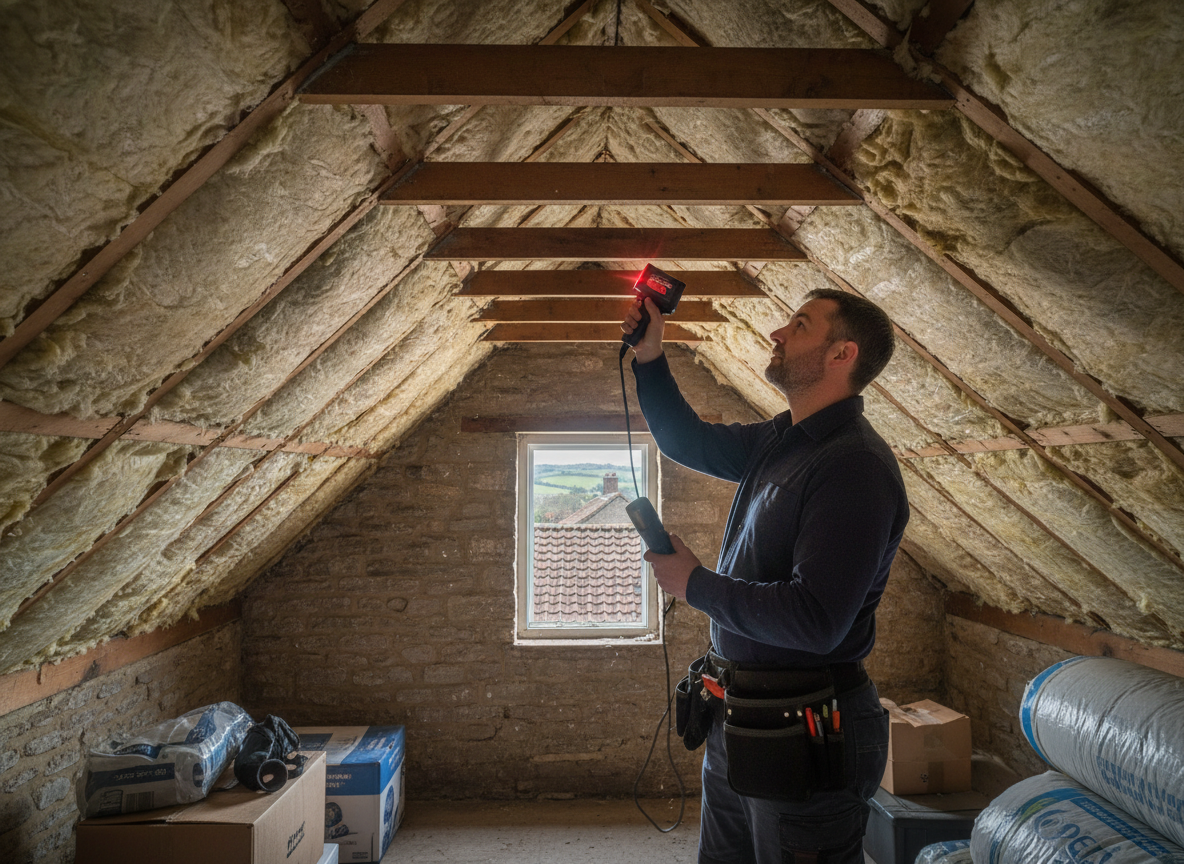
Bridgwater's older terraced and semi-detached homes, many built before 1960 along streets like Bristol Road and in the Sydenham area, often contain spray foam insulation applied directly to roof voids or walls during the 2000s energy grants. These installations trap moisture against the original lath and plaster or masonry because Somerset's frequent winter rainfall and high water table prevent proper drying. An assessment starts with borescope inspection through existing vents and thermal imaging to map cold spots where foam has detached or started to degrade.
Homeowners in the Bridgwater area frequently discover that foam applied over unventilated lofts has accelerated timber decay in rafters, especially on north-facing roofs exposed to prevailing winds off the Quantock Hills. We check for the tell-tale signs of hydrolysis in polyurethane foam, which turns soft and crumbly, and test adjacent timbers for rot. Assessments also include checking party walls in terraces where foam may have bridged into neighbouring properties, creating shared liability issues under typical Somerset leasehold arrangements.
We examine external walls in post-war estates such as those near the Bridgwater docks for closed-cell foam that was sprayed without proper substrate preparation, leading to delamination when salt-laden air from the River Parrett corrodes fixings. The assessment records insulation thickness, adhesion quality, and any evidence of previous water ingress from blocked gutters common on Victorian stock. Findings determine whether full removal is required or if targeted extraction can preserve sound sections without disturbing asbestos-containing artex ceilings still present in many TA6 homes.
Final reporting includes annotated photos and moisture meter readings taken at multiple depths, giving owners clear documentation before engaging removal contractors. This step prevents unnecessary work on properties where the foam remains stable despite cosmetic staining.
Technician insight
In Bridgwater, the thing that catches most people out with insulation assessment is how often spray foam in 1930s terraces has wicked moisture from the underlying stone walls because the original lime pointing was never repointed before the foam went in.
Hidden Rot Found in Sydenham Terrace
A homeowner on a terraced street near the old docks called after noticing musty smells. We found spray foam had been applied over damp masonry without a vapour barrier. Probing revealed extensive rafter rot along the party wall. We documented the extent and advised full removal plus timber treatment before any re-insulation.
How it works
- 1
Initial Site Walkthrough
We inspect the full property including loft, walls, and external elevations in Bridgwater to locate all foam applications.
- 2
Diagnostic Testing
Borescope and moisture meter readings are taken at key points to assess adhesion and hidden water damage.
- 3
Thermal Imaging Survey
Infrared scans identify cold bridging and areas where foam has failed to bond with the original structure.
- 4
Detailed Report Delivery
A written assessment with photos and recommendations is provided within 48 hours of the visit.
Pricing
Assessments are charged as a standalone service with the fee credited against any subsequent removal work booked.