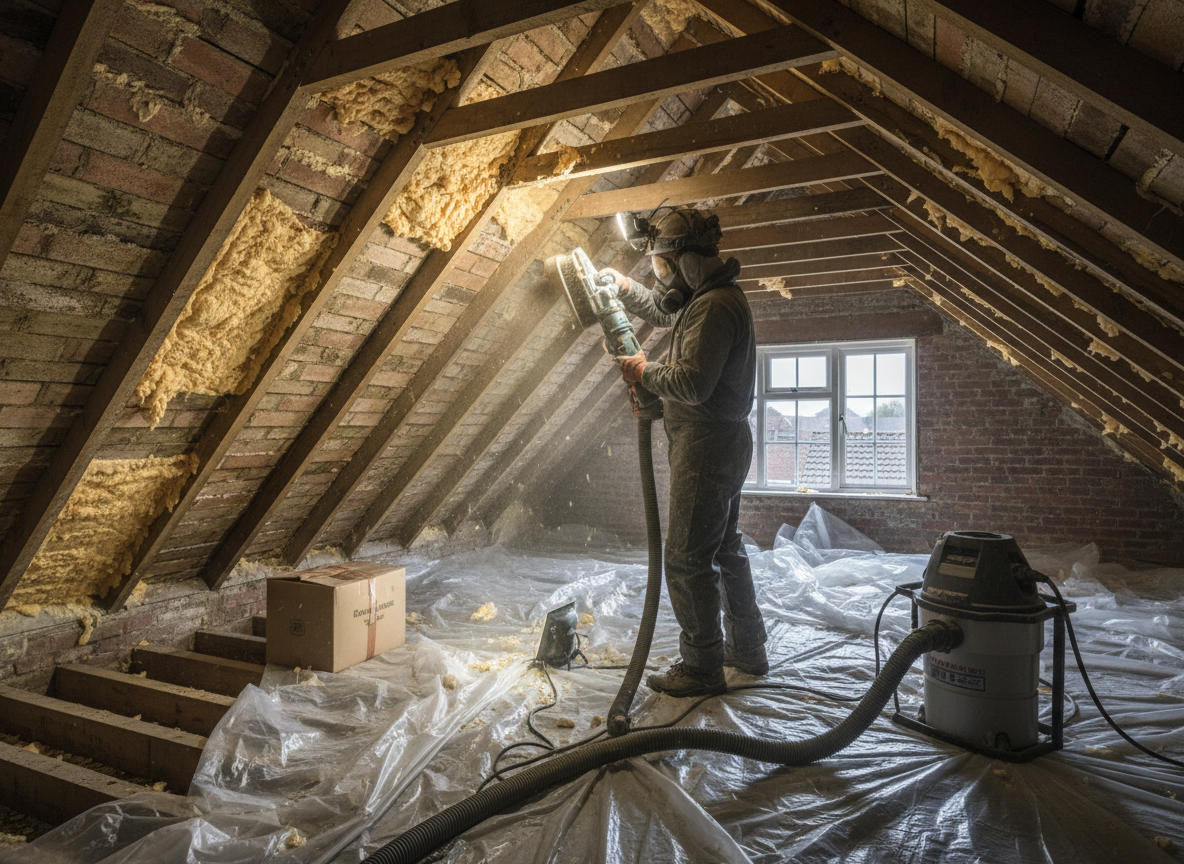
Spray foam installed in Bridgwater roofs and lofts often traps moisture against timber in Victorian and Edwardian terraces common along the Bridgwater Canal and in areas like Sydenham and Newtown. Removal requires cutting back the foam in controlled sections to avoid damaging original lath and plaster ceilings below while checking for hidden rot in rafters that the closed-cell material has concealed. Local weather patterns with frequent winter rainfall and high humidity make it essential to ventilate the space immediately after extraction and install temporary breathable membranes until permanent insulation is replaced.
Edge cases in the Bridgwater area include properties near the River Parrett where groundwater levels rise during prolonged wet spells, pushing damp into wall cavities that spray foam has sealed. Technicians must test substrate moisture content before finishing and may need to coordinate with local building control if structural timber replacement is required. Older homes around Taunton Road frequently have multiple layers of previous insulation, so full removal involves sequential stripping to reach the original deck without disturbing asbestos-containing materials sometimes found in mid-century extensions.
Handling Damp Substrates in Somerset Properties
After foam removal, surfaces in Bridgwater homes often show staining from condensation that built up behind the insulation. We use moisture meters calibrated for timber and masonry to map affected zones and advise on drying times based on current weather before any new work proceeds.
Why Local Housing Stock Changes the Job
Bridgwater's mix of terraced and semi-detached houses from the 1900s onward means access is usually through small loft hatches rather than full roof stripping. This limits equipment size and requires hand tools for precise foam separation to protect electrical cables and pipework routed through the same voids.
Technician insight
In Bridgwater the thing that catches most people out with spray foam removal near me is how quickly moisture builds behind the foam in the older terraces around the town centre once winter temperatures drop and the River Parrett levels rise. Homeowners assume the foam has protected the roof but it has actually hidden rot in rafters that only shows after we strip it back.
Hidden Rot in Sydenham Terrace
Homeowner in a 1920s terrace near the canal noticed ceiling staining after heavy autumn rain. We found closed-cell foam had sealed damp into the rafters with no ventilation path. After careful sectional removal and moisture mapping we cleared the affected timber sections and advised on drying before new insulation.
How it works
- 1
Site Inspection
Assess foam condition, substrate type, and any signs of trapped moisture in the specific Bridgwater property.
- 2
Safe Extraction
Remove foam in sections using appropriate tools while protecting ceilings, wiring, and original timber.
- 3
Moisture Check
Test rafters and decking for damp, especially after Somerset winter rainfall.
- 4
Clearance and Advice
Remove all debris and provide guidance on next steps for insulation or repairs.
Pricing
Upfront quotes after inspection; cost varies with access difficulty and extent of hidden damage in older Bridgwater homes.